

Divorce Papers in Pakistan – NADRA Divorce Certificate, Talaq & Khula Registration
Official Records Needed To Document A Separation
Divorce papers in Pakistan form a chain of legal and administrative records. A talaq notice, a signed settlement, a Family Court decree and a computerized divorce certificate perform different functions. The correct file depends on the marriage, the legal route, the competent authority and the purpose for which proof is required. Check these matters before signing a template or paying for certificate processing.
Divorce Documentation And Legal Requirements In Pakistan
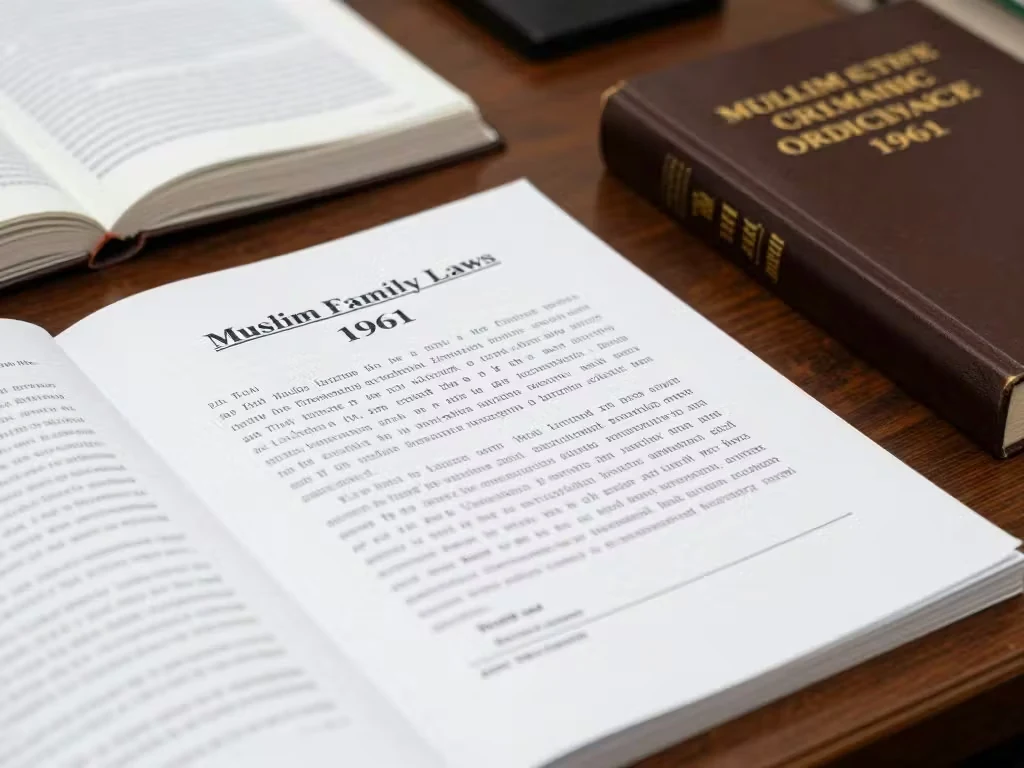
Divorce documentation in Pakistan must be assessed under the applicable legal route. For Muslim marriages, the Muslim Family Laws Ordinance, 1961 and relevant family-court legislation are important starting points. A notice, deed, decree and official certificate serve different purposes. Missing or disputed steps require legal review; a blanket statement that every unregistered divorce is automatically invalid is not a reliable assessment of an individual case.
Union Council and NADRA Responsibilities
The competent Union Council or other authorized local-government office handles the relevant civil-registration record. NADRA supplies civil-registration technology through its CRMS arrangements with provincial and local governments. The expression “NADRA divorce certificate” does not mean that every NADRA identity-card counter can decide a divorce or issue the underlying local-government record. Check the issuing authority printed on the certificate and the service available in the relevant district.
See NADRA’s official description of the civil-registration system. Identity-record modification and an application for a marriage or divorce certificate are separate requests even where a digital service connects parts of the process.
Key Legal Requirements
- Identify the applicable law and the correct authority.
- Check the Nikahnama and identity details against the original record.
- Prepare the appropriate notice, petition or agreement.
- Retain evidence of required service and official receipt.
- Confirm the relevant procedural periods and any pregnancy-related issue.
- Complete the applicable official record and certificate steps.
Requirements differ by route and location. Ask the responsible office for its current checklist instead of treating an online list as universally mandatory. A separate NADRA identity-record update should not be confused with the authority responsible for issuing a divorce certificate.
Documents for Certificate Review
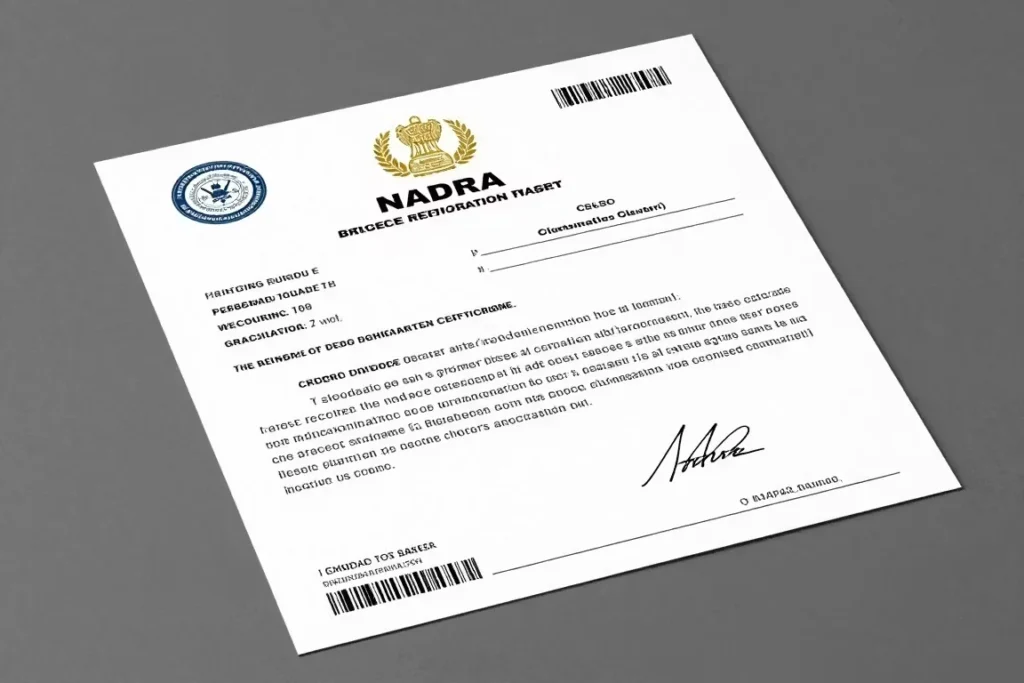
The responsible office should confirm its current requirements. Common records for review include the Nikahnama, identity documents, relevant notice or decree and evidence of official receipt. Photographs, certified copies and other supporting material should be prepared according to the actual checklist rather than an assumed nationwide rule.
Application and Follow-up
- Identify the competent issuing office.
- Obtain its current document checklist and fee information.
- Check names, dates and reference numbers.
- Submit the required papers and keep an acknowledgment.
- Respond to any verification request.
- Check the final certificate against the underlying record.
Punjab’s official e-Khidmat divorce-certificate service provides a provincial service reference. Confirm local arrangements elsewhere; this is not a universal NADRA-counter procedure.
Computerized Marriage Certificate Issuance
A computerized marriage certificate records marriage particulars; it does not replace the Nikahnama’s contractual terms or establish that a later divorce is complete. Start with the office holding the marriage-registration entry. Supply the required application and identity documents, have the record checked, pay the notified charge through an authorized channel and compare the issued certificate with the Nikahnama. Where the underlying entry is missing or disputed, resolve that issue through the proper registration or correction process before relying on a computerized printout.
Separate The Certificate Application From The Legal Process
First establish the relevant notice, decree or other lawful basis. Next confirm that the competent office has received and recorded the required material. Then submit the certificate request and respond to any verification query. Finally, check and collect the document. Keep the acknowledgment and application reference so that a later follow-up concerns an identifiable file rather than a verbal assurance.

Legal Assistance With Divorce Documents
If the document process is unclear, a lawyer can review the available records, identify missing papers and help you approach the competent office. Ask for a written scope covering drafting, submission support and follow-up; no adviser can guarantee approval or a fixed processing date.
Talaq Registration Procedure
For the statutory notice process, section 7 requires written notice to the Chairman and a copy to the wife after pronouncement. It does not set a universal seven-day notice deadline. The ninety-day period runs from delivery to the Chairman, subject to revocation and pregnancy provisions.
Preparing The Notice File
- Review the marriage record and the parties’ correct names.
- Confirm the competent authority and service addresses.
- Keep the signed notice and complete enclosures.
- Retain dispatch, delivery and acknowledgment records.
- Record subsequent communications and appointments.
Understanding The Timeline
Distinguish the pronouncement date, delivery date, statutory period and certificate-processing stage. These are not necessarily the same date. Ask counsel to explain the application to your facts rather than using a day-by-day template as a legal conclusion.
Rights and Responsibilities During Talaq
Ask counsel to review dower, maintenance, residence concerns, belongings and child-related issues separately. The relevant claims depend on the marriage record, facts, applicable law and existing orders. A notice alone does not resolve every financial or parenting dispute.
Keeping An Accurate Financial Record
List payments made and received, identify disputed amounts and retain receipts or bank records lawfully available to you. If the procedure or marital status is disputed, obtain advice promptly. Do not assume that every challenge is subject to the same deadline or that a general online statement determines your rights.
Khula And Family Court Proceedings
A wife considering judicial khula should have the proposed relief and its financial implications explained before filing. A claim based on statutory grounds is a distinct matter and should not be confused with khula merely because both concern dissolution.
Preparing For Family Court Proceedings
- Review the Nikahnama, identity documents and relevant facts.
- Identify jurisdiction and the appropriate relief.
- Prepare the petition and supporting material.
- Arrange service and comply with court directions.
- Participate in the relevant proceedings through the required process.
- Obtain and review the decree and follow-up requirements.
Court proceedings and the Union Council’s administrative role should not be described as one interchangeable process. Your lawyer should explain which stage applies.
Khula Proceedings And Timeframes
Timeframes vary with service, disputed issues and court scheduling. A fixed three-to-six-month promise should not be used to predict an individual case.
Documents For A Khula Consultation
- Nikahnama or available certified marriage record
- Identification and current address information
- Existing notices, petitions and orders
- Details of children and related proceedings
- Dower and payment records
- Other evidence relevant to the relief sought
After a decree, ask counsel to identify any remaining communication, official-record or certificate steps. Keep certified copies where required and follow up on discrepancies promptly.
Follow Up On Transmission of A Khula Decree
Obtain a certified decree and confirm its dispatch to the concerned authority, the dispatch reference and evidence of receipt. Punjab’s statutory provision on intimation to the Arbitration Council requires the Family Court to send a certified dissolution decree and directs the Chairman to act on its receipt. Confirm the applicable provincial provision and the actual case record; the decree date, dispatch date and receipt date should not be treated as interchangeable.
If the receiving office cannot locate the decree, ask the court office about a certified copy or renewed transmission through the proper channel. Do not substitute an edited scan or an unsigned private summary. Retain both the judicial record and the eventual administrative certificate. The Punjab Family Courts amendment text explains the provincial transmission provision.
Financial Aspects of Khula
Discuss dower and any proposed surrender or return of benefits before choosing the relief and signing documents. Khula and dissolution on other legal grounds can have different consequences. The actual result requires assessment of the claim, governing law and court decision; it should not be reduced to an automatic rule about cruelty or a general promise of waiver.
Mutual Divorce Agreement In Pakistan
Where both spouses agree to separate, a lawyer can assess whether mubarat or another appropriate route fits the facts. Agreement may reduce disputed issues, but it does not guarantee the fastest outcome or remove required formalities.
Advantages of Mutual Divorce
- Faster than a contested divorce
- Lower legal costs
- Less emotional stress
- Privacy maintained
- Flexible settlement terms
- No lengthy court battles
Considerations
- Both parties must agree.
- Requires mutual consent
- Still needs union council registration.
- Reconciliation period applies
- Legal documentation necessary
Mutual Divorce Deed Contents
- Statement of mutual consent to divorce
- Settlement of haq mehr (dower)
- Child custody arrangements
- Monthly child maintenance amount
- Division of marital property
- Wife’s maintenance during the Iddat period
- Visitation rights for children
- Any other agreed terms
Mutual Divorce Registration Process
Review the proposed deed with attention to consent, identity details, payment terms and unresolved matters. Ask counsel to identify the notice and administrative steps applicable to the route. Keep a signed copy, evidence of submission and records of compliance.
Before accepting a settlement, each spouse should understand whom the adviser represents and have an opportunity to obtain independent advice. Child-related arrangements and property claims should be assessed on their own facts. Do not assume a private agreement alone establishes the final legal status or foreign recognition.
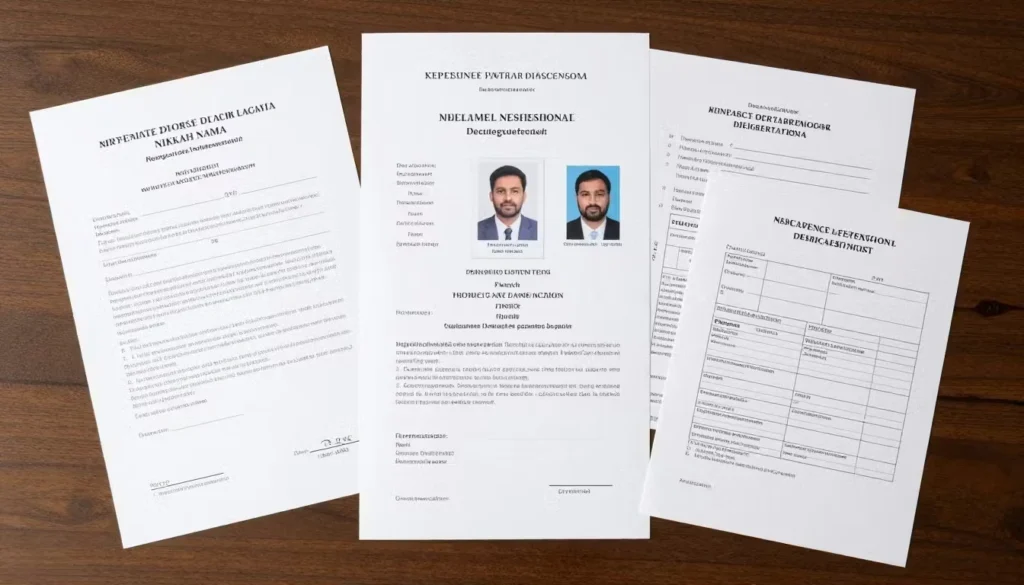
Prepare A Route-Specific Document File
| Record | Purpose | Check Before Submission |
|---|---|---|
| Nikahnama and Marriage Record | Identify the registered marriage | Registration entry, names and date |
| CNIC, NICOP or Passport | Establish identity | Valid details and matching spellings |
| Notice, Deed or Certified Decree | Identify the legal route | Signatures, reference numbers and operative terms |
| Service and Receipt Evidence | Document communication | Recipient, delivery date and acknowledgment |
| Authority To Represent | Define permitted acts | Required execution and authentication |
Obtain the office-specific checklist for originals, copies, photographs and supporting declarations. Keep originals available for inspection and obtain a receipt if an office retains them. A generic list cannot establish which documents are mandatory in every province or for every form of dissolution.
Document Preparation Assistance
Union Council’s Role In The Divorce Process
The competent authority should be identified from the relevant law and facts rather than simply choosing the nearest office.
Arbitration Council And Reconciliation
Section 7 provides for an Arbitration Council to attempt reconciliation. Keep its communications and obtain advice on participation, representation and the effect of any alleged revocation.
Record The Important Dates
Maintain a timeline of notices, official receipt, meetings and later documents. Do not assume the notice’s printed date alone determines effectiveness, or that either spouse’s informal statement automatically resolves a disputed status. Obtain advice before relying on the record for remarriage or another significant legal purpose.
Key Legislation
| Muslim Family Laws Ordinance | 1961 | Divorce notice, reconciliation period, union council registration |
| Dissolution of Muslim Marriages Act | 1939 | Grounds for wife to seek divorce, court procedure |
| West Pakistan Family Courts Act | 1964 | Family court jurisdiction, khula proceedings |
| Guardian and Wards Act | 1890 | Child custody matters after divorce |
Rights Protected By Law
Women’s Legal Rights
- Right to seek khula in court.
- Right to maintenance during Iddat
- Right to claim unpaid dower.
- Right to child custody for young children
- Right to challenge improper talaq.
- Right to property settlement
Men’s Legal Rights
- Right to pronounce talaq.
- Right to contest khula.
- Right to child visitation
- Right to revoke talaq during Iddat.
- Right to fair arbitration
- Right to appeal court decisions.
Common Mistakes To Avoid
Using The Wrong Office Or Procedure
Confirm jurisdiction and the correct application route before submission. A convenient office or familiar template may not be appropriate to the case.
Incomplete Or Inconsistent Records
Check names, identity numbers, dates and marriage particulars across all documents. Ask how discrepancies should be corrected before reproducing them in further papers.
Missing Service Evidence
Retain receipts, acknowledgments and returned envelopes. Tell counsel about an unknown address or failed delivery rather than assuming service is complete.
Confusing Certification With Identity Updates
Ask which authority issues the divorce certificate and whether any separate identity-record update is needed. Do not assume a visit to any NADRA counter completes the legal process.
Relying On Guaranteed Timelines
Official verification, hearings and missing records may affect progress. Request clear stage-based updates and retain the application reference number.

Arrange A Legal Consultation
Discuss the record you already hold, the document you need and the intended use. Ask for an explanation of the proposed work and professional charges. A telephone appointment can help identify the appropriate next step.
Our Services Include
Talaq Registration
- Notice drafting and filing.
- Union council liaison
- Documentation preparation
- Certificate collection
Khula Court Cases
- Petition drafting and filing
- Court representation
- Evidence preparation
- Decree execution
Certificate Documentation Support
Review of supporting papers, guidance on the competent issuing office, application preparation and follow-up within the agreed scope. Official verification and issuance remain with the responsible authority.
Document Review Before Submission
Before submitting an application, compare the complete set of papers against the issuing authority’s checklist. Check spelling in English and Urdu where relevant, identity numbers, the marriage-registration entry and all dates. Where an entry is disputed, explain the issue and seek the proper correction route rather than creating an altered copy.
Keep a separate record of the legal process and the administrative application. One file can contain notices, service records and orders; another can hold certificate applications, receipts and collection correspondence. This makes it easier to identify whether a delay concerns the underlying proceedings or a missing administrative document.
Using Documents Overseas
Obtain the receiving authority’s requirements before arranging translation or attestation. A document acceptable for one administrative purpose may not establish recognition for another. Disclose foreign proceedings or orders to your lawyer and seek advice in the other jurisdiction where needed.
Appointment and Scope
For a review of divorce paperwork, call +92 331 6644789. Explain whether you need drafting, review of an existing notice, assistance after a decree or a certificate application. Agree on the scope and fee before work begins.
Related Legal Guidance
For related advice, see divorce certificate documentation and the talaq notice process. The statutory starting point is the Muslim Family Laws Ordinance, 1961.
Overseas Applicants: Authorization and Foreign Use
Establish The Required Authority Before Signing
Tell counsel where each spouse lives, where the marriage was registered, whether foreign proceedings exist and which document the receiving institution needs. Confirm jurisdiction before arranging an overseas signature. A power of attorney should identify the representative and the authorized tasks, such as collecting certified copies or presenting an application. Authority to collect a document should not be assumed to include authority to surrender financial claims or agree to a settlement.
Check the relevant Pakistan mission’s execution requirements and whether its online power-of-attorney service is available for the intended transaction. Provide the identification and witness material requested by that mission. Arrange any required original delivery and retain the authenticated instrument. Representation does not automatically remove a court’s requirement for personal evidence or attendance.
Plan Attestation, Translation and Recognition Separately
Obtain a written checklist from the overseas registry, immigration authority or court before paying for translation. Ask whether it requires the decree, certificate, notice record, certified translation, apostille or consular legalization. MOFA’s published checklist contains specific requirements for divorce documents and representation by applicants living abroad. Confirm those requirements against the current service instructions when booking. The official MOFA checklist is the starting point.
An apostille concerns a public document’s origin rather than deciding the legal effect of the divorce in another country. Foreign recognition depends on the receiving jurisdiction and the facts, including jurisdiction and procedural fairness. A certificate acceptable to one institution may not resolve a separate dispute over marital status. Seek advice in the receiving country when recognition is contested.
Official Verification and Cost Controls
Verify The Issuing Record
- Compare the certificate with the original marriage record, identity documents and relevant notice or decree.
- Check the issuing office, record number, dates, signatures and seal.
- Contact the issuing authority through independently obtained official contact details and request its verification procedure.
- Use only an official portal identified by that authority where online verification is available.
- For an apostille, use the MOFA apostille verification service to verify the apostille itself.
- Resolve discrepancies through the issuing office and retain the written response.
A successful identity lookup is not, by itself, proof that every divorce notice, service step or decree is valid. Verification of a certificate and legal assessment of the underlying proceedings answer different questions. Avoid uploading full identity documents to an unofficial website that promises instant nationwide divorce verification.
Request An Itemized Estimate
Ask for the current issuing-office charge and distinguish it from certified copies, translations, authentication, courier expenses and professional fees. Published government schedules may describe only one component. Request receipts and confirm which services a quotation includes. Statutory waiting periods, court proceedings, record corrections and certificate printing also operate on different timelines; a processing estimate must identify the stage being estimated.
Divorce Registration and Certificate FAQs
Which Divorce Documents Should I Gather First?
Start with the Nikahnama, identity documents, any talaq notice or court decree, and delivery records. Keep the papers in date order. The responsible authority can then confirm which originals, certified copies and supporting documents are required for your specific route.
Are A Talaq Deed and A Divorce Certificate The Same?
No. A deed records a declaration or agreement, while a certificate records the official outcome through the relevant authority. Ask a lawyer to check the full documentary chain rather than relying on the title printed on one paper.
Where Should I Apply for A Divorce Certificate?
Confirm the competent Union Council or local authority for your record. Punjab also provides a divorce-certificate service through e-Khidmat centres. Do not assume every NADRA counter issues divorce certificates or that the same process applies in every district.
Can A Missing Nikahnama Delay The Application?
It can prevent verification of important marriage details. Ask how to obtain a certified marriage-record copy from the relevant office. Explain any discrepancy in names, dates or registration particulars before preparing additional paperwork.
How Should Notice Delivery Be Documented?
Keep the signed notice, postal or courier receipts, tracking information and any official acknowledgment together. Preserve returned envelopes as well. Ask counsel how the evidence relates to the required method of service in your circumstances.
What If My Name Is Spelled Differently Across Records?
Prepare a list of the differences and identify the document containing the correct entry. Ask the issuing authority about its correction procedure. Avoid altering certificates yourself or submitting inconsistent versions without an explanation.
Does A Khula Decree End Every Administrative Step?
Ask counsel to confirm the decree’s terms and the remaining communication, record and certificate steps. Obtain certified copies where needed. Do not treat a photocopy or an informal message about the decision as a complete case file.
Can Someone Abroad Arrange Document Review?
Scanned copies can support an initial review, but originals, certification or authorization may still be required. Explain the country where the documents will be used and ask about translation, attestation and recognition separately.
How Can I Check The Expected Cost and Time?
Request the current official fee information and a separate written professional-fee quote. Ask which stages depend on service, hearings or record verification. No estimate should be understood as a guaranteed completion date.
What Should I Check Before Collecting The Final Certificate?
Compare names, identity numbers, marriage details and dates with the supporting file. Check the issuing office and ask how authenticity can be confirmed. Retain the certificate, underlying documents and receipts securely for future use.
Does NADRA Itself Decide Whether A Divorce Is Valid?
NADRA’s civil-registration technology and identity records do not replace the legal process or the competent issuing authority. Verify the local-government record and obtain legal review of any dispute about notice, service, jurisdiction or a decree.
What Union Council Fee Will I Pay?
Request the current schedule from the competent office. Separate its official charge from copies, translation, authentication, delivery and lawyer fees. A figure published for one location or service is not a reliable nationwide total.
When Does The Statutory Talaq Period Begin?
Under the section 7 notice framework, the ninety-day period runs from delivery of notice to the Chairman, subject to the applicable revocation and pregnancy provisions. It is not a promise that certificate printing will finish on that date. Confirm the law applicable to your circumstances.
Can I Obtain A Marriage Certificate Instead of A Divorce Certificate?
The documents record different events. A computerized marriage certificate confirms marriage-registration particulars; it does not show that a later dissolution process has been completed. Ask the receiving institution which records it requires.
Can An Overseas Representative Collect My Papers?
Confirm the issuing office’s authorization requirements and the precise scope of the power of attorney. Authentication and original-document requirements may apply. Permission to collect papers does not automatically authorize settlement of claims or dispense with required personal attendance.
Will An Apostille Guarantee Acceptance Abroad?
No. Authentication and legal recognition are distinct. Confirm the destination authority’s document and translation requirements and obtain local advice if recognition of the divorce is disputed.